Choosing between a handheld and a fixed OGI camera starts with one question: how do you need to detect gas leaks in your facility?
If your team performs scheduled inspections across multiple sites or equipment zones, a handheld optical gas imaging (OGI) camera offers the mobility and flexibility to scan where and when needed. If your facility runs continuously and requires unmanned monitoring of critical leak points — storage tanks, pipelines, compressors — a fixed-mount OGI system integrates with your control infrastructure and watches around the clock.
Both handheld and fixed OGI cameras rely on infrared absorption: target gases absorb radiation at specific wavelengths, creating image contrast that makes an otherwise invisible plume visible. The key difference is not the detection principle, but how each deployment model fits your operational workflow, staffing model, and safety requirements.
Quick Answer
| Factor | Handheld OGI | Fixed OGI |
| Primary use | Routine inspections, troubleshooting, spot checks | Continuous and unmanned monitoring |
| Coverage | Flexible — scan multiple areas per shift | Fixed view — covers designated zone 24/7 |
| Integration | Standalone or Wi-Fi export | Native Modbus TCP, ONVIF, and direct SCADA integration |
| Response time | During scheduled rounds | Alarm on detection within the configured field of view |
| Best for | Mobile teams, varied equipment, and compliance audits | Critical infrastructure, remote facilities, explosion-risk zones |
The sections below explain how each option works, where each excels, and how to match the right camera to your specific gas detection needs.
How OGI Cameras Detect Gas Leaks
OGI cameras are specialized gas leak detection cameras that detect leaks by exploiting the infrared absorption characteristics of specific gases. When a gas cloud is present between the camera and a background surface, the gas absorbs infrared radiation at its characteristic wavelength. The camera registers the reduced infrared intensity and renders the gas cloud as a visible overlay against the thermal image.
This approach differs fundamentally from traditional point detectors or sniffers. Point sensors measure concentration at one spot. They cannot reveal where the leak originates or how the plume spreads across flanges, valves, and seals at height or behind structures. Technicians often must climb, probe, or take equipment offline to find the source. OGI cameras visualize the gas cloud directly across a wide field of view, pinpointing the exact component that needs attention without physical contact or shutdown.
Common detectable gases include methane, sulfur hexafluoride (SF₆), ammonia, ethylene, propylene, and various refrigerants. Different OGI cameras use different spectral filters tuned to specific gas absorption bands, so matching the camera to your target gas is essential.
OGI detection has clear boundaries. Not all gases absorb infrared radiation in the bands that OGI cameras can image. The camera must use a filter that matches the target gas’s absorption spectrum. Detection performance also depends on background temperature contrast, wind speed, humidity, viewing distance, leak rate, and the angle between the camera and the gas plume. OGI visualizes the presence and location of a leak, but it does not directly measure concentration. For quantitative readings, supplemental gas analyzers or sniffers are still necessary. Strong sunlight or intense artificial lighting can also mask gas signals or create reflections off smooth surfaces that interfere with the thermal image. In practice, OGI works best as part of a layered detection strategy rather than a standalone solution.

For a deeper look at detection principles and advantages across industries, see how gas detection with infrared thermal imaging works in petrochemical, power, and environmental applications.
Handheld OGI Cameras: Best for Mobile Inspection
Handheld OGI cameras are portable devices designed for operators who walk the facility, scan equipment, and document findings in the field.
Key Capabilities
A handheld unit like the RG630F OGI handheld camera combines a 640 × 512 uncooled VOx detector with 15 mK thermal sensitivity and a gas-specific filter to detect SF₆, ammonia, ethylene, and other gases. The camera displays both infrared gas imaging and a visible-light reference on the same screen. This dual-spectrum overlay makes it easy to identify which valve or flange is leaking without cross-referencing separate images. Most handheld units record still images with embedded radiometric data and stream full radiometric video to a PC in real time, creating a complete thermal record for compliance reporting and maintenance.
Explosion-proof ratings matter in oil, gas, and petrochemical environments. The RG630F carries an Ex ic IIC T4 Gc rating. Always confirm that the certification matches the specific hazardous area classification before deployment.

When Handheld OGI Makes Sense
- Varied equipment across a large site: One camera covers storage tanks, pipelines, compressors, and process units in a single inspection round.
- Troubleshooting after an alarm: When a fixed sensor indicates a leak somewhere in a zone, a handheld camera quickly narrows down the exact source.
- Compliance audits and regulatory reporting: Documented thermal videos provide visual proof of leak detection and repair for environmental inspectors.
- Budget constraints for pilot programs: A single handheld unit requires no infrastructure investment, making it easier to justify before scaling to fixed systems.
Pre-Inspection Checklist for Handheld Use
Before deploying a handheld OGI camera, confirm:
- The target gas matches the camera’s spectral filter.
- The inspection route and frequency cover high-risk equipment.
- Operators are trained on camera operation and leak documentation.
- Video or image archiving procedures are in place for compliance.
- Personnel can access the area safely under site entry rules.
Fixed OGI Cameras: Best for Continuous Monitoring
Fixed OGI cameras mount permanently and monitor a designated area continuously. They connect directly to plant control systems, triggering alarms and logging events without requiring an operator on site.
Key Capabilities
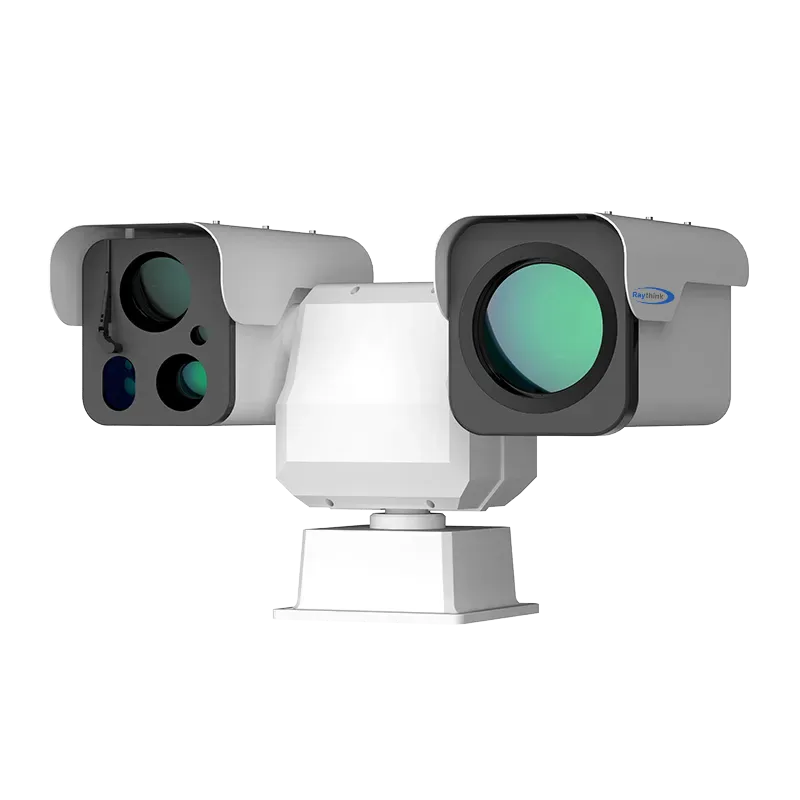
The TE464G1 explosion-proof gas imaging PTZ uses an uncooled detector with continuous pan-tilt-zoom rotation, allowing a single camera to patrol multiple preset positions across a wide area. The dual-spectrum design combines thermal gas imaging with a visible-light camera. When a leak is detected, the system captures both the gas cloud image and a visible reference for verification. Fire point detection adds another layer of safety in high-risk environments.
Fixed systems integrate directly into existing infrastructure through Modbus TCP and ONVIF protocols. Gas detection rules and temperature alarm rules can trigger alarm actions, such as notifying operators, starting video recording, or executing preset PTZ responses automatically.

When Fixed OGI Makes Sense
- Critical infrastructure that cannot wait for the next inspection round: Storage terminals, compressor stations, and process units where a leak means immediate safety or environmental risk.
- Remote or unmanned facilities: Sites where sending an inspector is costly, slow, or unsafe. The camera watches continuously and reports back to a central control room.
- Explosion-risk zones requiring certified equipment: The TE464G1 carries Ex d IIC T6 Gb / Ex tD A21 IP68 T80℃ dual certifications with a stainless steel body, meeting stringent hazardous area requirements.
- Integration with SCADA or DCS systems: When gas detection needs to support automatic alarm workflows — such as operator alerts, video recording, ventilation control, or safety interlock signals — a fixed camera with native protocol support is the practical choice.
Pre-Deployment Checklist for Fixed OGI
Before installing a fixed OGI system, verify:
- The field of view covers all high-risk points with minimal blind spots.
- Physical obstructions — pipes, structures, vessels — do not block the sightlines.
- Mounting height and angle are optimized for the target leak sources.
- Explosion-proof certification matches the zone classification.
- Network, power, and SCADA interfaces are available at the installation location.
- Alarm thresholds and false-alarm handling procedures are defined.
Handheld vs Fixed OGI: Key Differences
Integration with Control Systems
Handheld cameras typically store data on internal SD cards or export via Wi-Fi to a PC for analysis. Some models support PC software and mobile apps for report generation. This workflow works well for periodic audits but does not provide real-time integration with plant control systems.
Fixed cameras connect via Ethernet to SCADA, DCS, or VMS platforms. They push alarm signals directly into the control logic, enabling automated responses. For facilities already running Modbus TCP for equipment communication, a fixed OGI camera adds gas detection as another data point without new protocol converters.
Coverage Model
A handheld camera covers whatever the operator points it at. One inspector with one camera can scan dozens of components in a shift, but only during that shift. Between inspection rounds, leaks go undetected.
A fixed camera covers its assigned field of view continuously. It never takes a break, never misses a shift change, and operates in weather conditions that might delay a walking inspection. The trade-off is coverage area: one camera sees one zone. Large facilities need multiple units.
Response Time
Handheld detection is as fast as the operator can reach the equipment and scan it. For facilities on daily or weekly inspection cycles, this means a leak can persist for hours or days before detection.
Fixed detection can trigger alarms as soon as a gas plume appears within the camera’s configured field of view. Response depends on alarm logic and network latency, but in most cases operators are notified within seconds. This reduces the total release volume and the associated safety risks and regulatory exposure.
Total Cost Picture
A handheld OGI camera is a single capital purchase. It needs no installation infrastructure beyond charging and data export. Training is focused on the operator. Ongoing costs are minimal — mainly calibration and battery replacement.
A fixed OGI system involves camera hardware, mounting infrastructure, cabling, network configuration, and integration engineering. The upfront investment is higher. The return comes from reduced labor for manual rounds, faster leak response, and the ability to monitor unmanned or hazardous zones without putting people at risk.
Choose Handheld or Fixed?
| Choose handheld if… | Choose fixed if… |
| Leak points are mobile or spread across a wide area | Leak points are fixed, and the consequence of delay is high |
| Budget limits you to a single device with no infrastructure | Budget supports hardware, mounting, cabling, and integration |
| The need is compliance audits and spot troubleshooting | The need is for automatic alarm and safety interlock integration |
| High-risk zones have not been identified yet | High-risk zones are defined and require round-the-clock coverage |
| Area has structural obstructions that block any fixed sightline | Personnel entry is restricted, costly, or unsafe |
Application-Based Recommendations
Oil and Gas Storage Terminals
Tank breather valves and foam generators sit ten meters or more above ground — difficult and dangerous to reach by ladder for manual inspection. A fixed OGI PTZ at the terminal perimeter scans these high-mounted leak points from a safe distance on programmed patrol routes. Handheld cameras step in after an alarm for close-up verification of the exact valve or seal.
Petrochemical Processing Plants
Process units contain hundreds of flanged connections on compressors, heat exchangers, and pressure vessels — too many for manual sniffing or visual checks to cover reliably. Fixed cameras monitor high-risk zones continuously for leaks that start between inspection rounds. Handheld units verify the exact flange or seal during turnaround maintenance or after process upsets.
Power Substations (SF₆ Monitoring)
SF₆ in high-voltage switchgear is invisible and odorless. Traditional leak detectors often require taking equipment offline to trace a source, disrupting grid operations. Fixed OGI cameras with sightlines into switchgear bays detect SF₆ leaks while equipment stays energized. For broader substation monitoring strategies, see substation monitoring and inspection using infrared non-contact temperature measurement. Handheld cameras support annual audits without scheduled outages.
Natural Gas Pipeline Stations
Pipeline compressor and metering stations operate in remote locations with hundreds of sealed connections where leaks often appear as tiny, invisible streams. Traditional methods struggle to catch these micro-leaks during routine rounds. Fixed OGI systems provide continuous monitoring with alarm output to a remote operations center. Handheld units support monthly field inspections of above-ground piping and station equipment.
When to Use Both
Many facilities use both handheld and fixed OGI cameras. A common approach:
- Fixed cameras monitor high-risk points continuously — tank farms, compressor stations, switchgear bays — where a leak would have immediate safety or environmental impact.
- Handheld cameras confirm alarms — when a fixed camera triggers an alert, an operator takes a handheld unit to the exact location to assess severity and plan repair.
- Handheld cameras cover blind spots — fixed cameras cannot see around corners or inside crowded pipe racks. Handheld units fill these gaps during scheduled rounds.
- Handheld cameras support LDAR and compliance programs — annual or quarterly regulatory inspections require documented visual evidence that fixed systems alone may not provide across the entire facility.
Decision Checklist
Choosing between handheld and fixed OGI cameras is not about which technology is better. It is about which deployment model matches how your facility operates.
If your priority is flexible inspection coverage across varied equipment with minimal infrastructure, a handheld OGI camera is the practical starting point. If your priority is continuous monitoring of critical zones with real-time alarm integration into your control system, a fixed OGI system is the better fit.
Many facilities eventually use both: fixed cameras for continuous monitoring of high-risk areas, and handheld cameras for troubleshooting, audits, and coverage of equipment not under fixed monitoring.
Your selection checklist:
- List the gases you need to detect and confirm spectral compatibility.
- Identify which zones need continuous monitoring versus periodic inspection.
- Determine whether real-time SCADA integration is required.
- Evaluate hazardous area certification requirements for each zone.
- Calculate the total project cost, including installation, integration, and training.
- Plan for calibration and maintenance schedules.
For facilities monitoring methane, SF₆, or refrigerant leaks in hazardous environments, review optical gas imaging cameras for detection ranges, gas compatibility, and integration options. The right camera — handheld, fixed, or a combination of both — can help reduce detection blind spots and support facility safety and compliance programs.
Recommended Raythink Models
| Need | Better Fit | Model | Why |
| Mobile inspections across varied equipment | Handheld | RG630F | Portable, 15 mK sensitivity, gas-specific filter, dual-spectrum overlay, Ex icIIC T4 Gc rated |
| 24/7 unmanned monitoring with SCADA | Fixed | TE464G1 | PTZ patrol, dual-spectrum, Modbus TCP/ONVIF, Ex d IIC T6 Gb rated |


Handheld and Fixed OGI Cameras FAQ
Can one OGI camera detect all types of gases?
No. OGI cameras use spectral filters tuned to specific gas absorption bands. A camera optimized for methane detection may not see SF₆, and vice versa. Some cameras detect multiple gases within the same spectral window — for example, certain refrigerants share similar absorption characteristics. Always verify that the camera’s detectable gas list matches the gases present in your facility.
How far can an OGI camera detect a leak?
Detection distance depends on gas type, leak size, camera resolution, and atmospheric conditions. Typical handheld units detect moderate leaks from 10 to 50 meters. Fixed systems with longer focal length lenses and higher sensitivity can extend this range. Small leaks or low-concentration plumes require closer proximity or more sensitive detectors.
Do OGI cameras replace traditional gas detectors?
Not necessarily. Traditional point detectors and sniffers provide quantitative concentration measurements at specific locations. OGI cameras provide qualitative visualization across a wide area. Many facilities use both: fixed point detectors for continuous concentration monitoring in enclosed spaces, and OGI cameras for visual leak location and area screening in open process areas.
What affects OGI detection performance?
Detection quality depends on the spectral match between the camera filter and the target gas, the temperature contrast between the gas plume and the background, wind speed and direction, humidity, viewing distance, leak rate, and the angle of observation. Low background contrast or strong crosswinds can reduce plume visibility even when a leak is present.
Conclusion
Handheld and fixed OGI cameras serve different but complementary roles in industrial gas leak detection. Handheld units deliver mobility, flexibility, and low entry cost for teams that perform scheduled inspections, compliance audits, and troubleshooting. Fixed units deliver continuous coverage, automatic alarms, and SCADA integration for critical infrastructure that cannot tolerate delays.
The right choice depends on your gas types, coverage requirements, integration needs, hazardous area classifications, and budget. Many facilities start with a handheld camera to build experience, then add fixed systems at the highest-risk zones. Over time, the combination of both provides the most complete protection against undetected leaks.