How far away can a thermal camera core detect, identify, and recognize a person, and what focal length lens is needed for that? For newcomers, they usually ask for a quote only after obtaining effective information and determining the target.
This article will introduce how to effectively and quickly assess the range of infrared thermal imaging cameras and the Johnson criteria used for this assessment.
Johnson Criteria
Provided that an infrared thermal imaging camera can see buildings several kilometers away, leading to the assumption that it can see that far. However, there is a misconception here: the size of the buildings is not considered. We can see the building through this infrared thermal imaging camera, but how clearly can we see it? How do we define this?
We need a relatively clear target value to make an assessment. Therefore, a standard of relative agreement is required to answer this question, which is the Johnson criteria.
Why Is It Called a Standard of Relative Agreement?
That is because numerous factors influence the results, such as atmospheric attenuation under different climatic conditions, detector thermal sensitivity, dead pixel noise, image algorithms, and the temperature difference between the target and background.
For example, assuming the sunlight is the only different condition: one can see further on a sunny midday than in the slanted afternoon sun. At the same distance, a lit cigarette butt will be clearer than leaves on a tree, even if the leaves are much larger. Additionally, regarding detector sensitivity, a 12µm core will perform better than a 17µm core in terms of visibility when using the same high-sensitivity lens.
Definition of Detection Distance
Detection distance is a combined result of subjective and objective factors. Subjective factors are affected by the observer’s visual psychology, experience, and other aspects. Therefore, to answer the question “How far can a thermal imager see?”, it is essential to define what “seeing clearly” means first. For instance, Observer A may believe they have seen a target clearly, while Observer B might disagree.
Therefore, there must be an objective and unified evaluation standard.
How Does the Johnson Criteria Define This Standard?
Johnson’s research connected target detection to equivalent stripe detection, demonstrating that it is possible to determine the recognition capability of an infrared thermal imaging system without considering the target’s nature or image defects.
The equivalent stripe pattern consists of black and white stripes with equal spacing, where the total height represents the target’s critical size. The resolution of this pattern is defined by the number of discernible stripes within the target’s critical size, which corresponds to the number of pixels occupied by the target’s image on the detector.
Levels of Target Detection
Target detection can be divided into three levels: detection (discovery), recognition, and identification.
1. Detection
This involves discovering a target within the field of view. At this stage, the target’s image must occupy more than one pixel in the direction of its critical size.
2. Recognition
This level allows for classifying the target, which means you can identify if the target is a tank, truck, person, or other category. Here, the target’s image must occupy more than four pixels in the direction of its critical size.
3. Identification
This means that you can distinguish between different models and other characteristics of the target, such as identifying a friend or foe. For this level, the target’s image must occupy more than eight pixels in the direction of its critical size.
All of these measurements are based on critical values, which means they represent the minimum conditions required to detect a target. According to the Johnson criteria mentioned earlier, how far an infrared thermal imaging camera can see is determined by factors such as target size, lens focal length, and detector performance.
Factors Determining Detection Distance of an Infrared Thermal Imager
1. Lens Focal Length
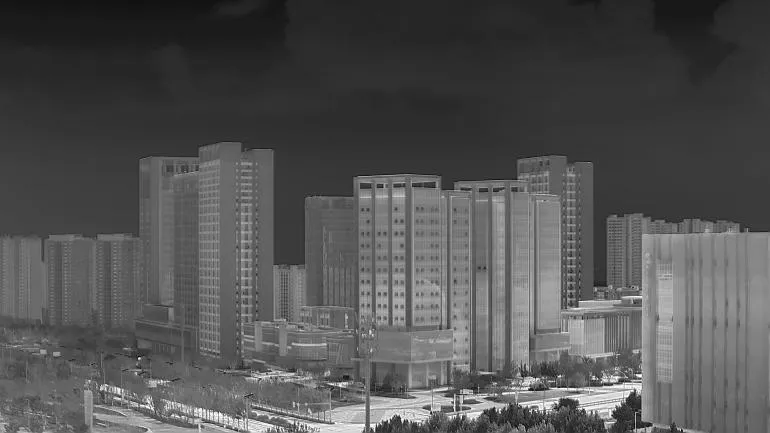
An important factor that determines the detection distance of an infrared thermal imager is the lens focal length. The focal length directly affects the image size formed by the target, which corresponds to how many pixels it occupies on the focal plane.
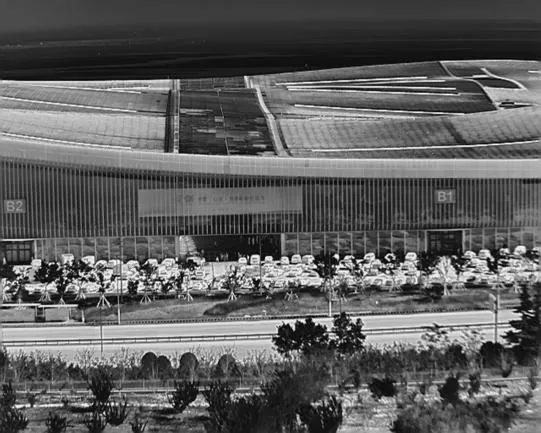
Comparison at 1920×1080 Resolution and 800m Observation Distance

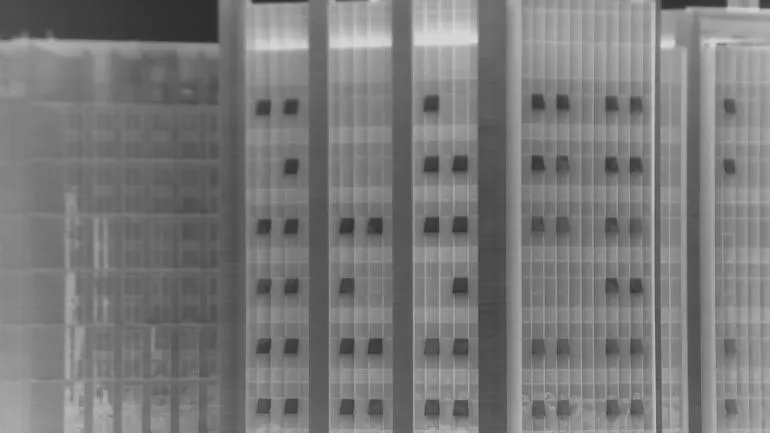
Comparison at 640×512 Resolution and 300m Observation Distance

The Relationship Between Focal Length And IFOV
This is typically expressed in terms of spatial resolution (IFOV), which indicates the smallest target area that each pixel of the infrared thermal imager sensor can detect at a unit test distance. The unit is mrad. It represents the system’s minimum angular resolution unit and is generally derived from the ratio of pixel size (d) to focal length (f), expressed as IFOV = d/f.
For example: Taking Raythink RM320 as an example, the pixel size is 12 microns, the lens focal length is 9.1mm, and the spatial resolution is 12/9.1=1.31mrad.
Calculating Pixels Occupied by Target Images on the Focal Plane
The number of pixels occupied by each target’s image on the focal plane can be calculated based on the target size, the distance between the target and the infrared thermal imager, and IFOV.
IFOV = d/f
n=(D/L)/IFOV=(Df)/(Ld)
“D” represents the target size
“L” represents the distance between the target and the infrared thermal imager
From this, it can be seen that a larger focal length results in more pixels being occupied by the target image, indicating a greater detection distance according to the Johnson criteria.
For example, with an infrared thermal imager that has a pixel size of 17µm and a 100mm focal length lens, the spatial resolution (IFOV) is 0.17 mrad. Observing a 2.3m target at a distance of 1-kilometer results in a target spatial resolution of 2.3mrad, which occupies 2.3/0.17=13.5pixels.
According to the Johnson criteria, this achieves an identification level.
2. Detector Performance
While the lens focal length determines the detection distance of an infrared thermal imager, another crucial factor in practical applications is the detector performance. The focal length only dictates the image size and the number of pixels it occupies, whereas detector performance affects image quality, including clarity.
Factors Affecting Detector Performance
Detector performance can be analyzed through aspects such as pixel size, thermal sensitivity, and signal processing.
Smaller pixel size leads to smaller IFOV, which, as discussed earlier, results in greater detection distances. For example, infrared thermal imagers with pixel sizes of 38µm and 25µm, both using a 100mm lens to observe a 2.3m target, would have recognition distances of 1 kilometer and 1.5 kilometers, respectively, according to the Johnson criteria.
Additionally, the thermal sensitivity and signal processing capabilities of the detector determine image clarity. If these factors are inadequate, the resulting image will be a blurry thermal representation, making recognition impossible.
3. Atmospheric Conditions
Although thermal radiation penetrates the atmosphere better than visible light, factors such as atmospheric absorption and scattering still affect thermal imaging, especially in heavy fog and rain, which can reduce the detection distance of infrared thermal imagers. For instance, long-wave infrared radiation has poor penetration in rain and fog, while mid-wave infrared can penetrate fog well but struggles in rain.
Some may also wonder if infrared thermal imagers can measure through objects. In most cases, they cannot; only materials like PVC film and certain specialized crystalline substances allow for this type of measurement.
How Far Can a Thermal Camera See?
In summary, how far can a thermal imager “see”? This capability is influenced by several factors, including the detector, lens, target, atmospheric conditions, as well as subjective human factors and software algorithms. Therefore, without considering the impact of other factors, the calculation should follow the formula below:
n=(D/L)/IFOV
=【target size(D)*focal length(f)】/【distance between target and infrared thermal imager(L)*pixel size(d)】
However, if atmospheric conditions are not considered, it is common to add 0.5 pixels as a standard for detection, 1 pixel for recognition, and 2 pixels for identification. This adjustment compensates for inconsistencies in detector sensitivity and lens quality, thereby increasing the number of pixels occupied by the target to ensure that customers achieve the desired results.