Infrared thermal cameras provide significant convenience and numerous applications in modern fields such as medical, construction, and security. However, why are these useful infrared thermal cameras so expensive? The main reason is that their production costs are inherently high.
This article will introduce the factors that influence the price of infrared thermal cameras, helping you understand why their production costs are so high.
Why Are Thermal Cameras so Expensive?
The main reasons for the high production costs are the lens, detector, circuitry, and algorithms.
1. Infrared Lens
Firstly, the lens of an infrared thermal camera is typically made from germanium glass, specifically high-purity single-crystal germanium. This material has a very high refractive index and is transparent only to infrared light while blocking visible light and ultraviolet rays. As a result, the infrared thermal camera can detect animals and plants in dark environments.
In addition to germanium glass, materials like zinc sulfide (ZnS) and zinc selenide (ZnSe) are also used in the production of infrared lenses. These materials also have good infrared transmittance. However, germanium glass is still the main material for infrared thermal imager lenses due to its excellent performance in the infrared spectrum and its wide application.
Moreover, the lens also contains a type of germanium called “optical-grade germanium,” which is not found in ordinary cameras. This is a very rare element, with almost no concentrated germanium deposits in nature, making it difficult to collect. The concentration of germanium in the Earth’s crust is only 0.0007%, further contributing to the high production cost of germanium lenses.
Especially for non-standard infrared lenses, the cost of the product is often more expensive than common infrared lenses when divided into R&D and production costs. As a result, sometimes when selecting an infrared thermal camera, the lens may end up being more expensive than the camera’s core itself.

2. Infrared Thermal Camera Detector
Infrared detectors are divided into two types: cooled and uncooled. Cooled infrared detectors are mainly used in high-end scientific research equipment and are very expensive.
Uncooled infrared detectors can operate at room temperature while their size and power consumption are significantly smaller than cooled infrared detectors. The vast majority of infrared thermal cameras used in civilian applications, utilize uncooled infrared detectors. As the bridge between sensing infrared radiation and outputting signals, the thermosensitive element is the core component of the infrared detector.
The thermosensitive elements of uncooled infrared detectors are primarily made from vanadium oxide (VOx) and amorphous silicon (α-Si).
Most civilian thermal imaging devices use vanadium oxide detectors. The detector determines the image resolution—the higher the resolution, the clearer the image, and the more expensive the device becomes. Vanadium oxide has a higher infrared radiation photoelectric conversion efficiency and provides good temperature measurement stability, with sensitivity reaching 25 mK. The cost of a vanadium oxide detector is roughly 200 times that of a standard CMOS sensor used in regular cameras. If you are familiar with photography, you can imagine just how staggering that price difference is.


3. Circuit Design of Thermal Cameras
The quality of an infrared thermal camera is influenced by whether its circuit design incorporates shutterless automatic calibration technology. Products with a shutter use it to adjust the circuit board’s temperature, which is a proven and reliable method. However, the use of a shutter may result in brief image pauses and could potentially impact circuit stability in certain scenarios. On the other hand, thermal cameras with shutterless automatic calibration technology eliminate image interruptions and offer enhanced performance, though this advanced technology typically comes with higher associated costs.
4. Algorithms
Thermal cameras rely on specialized sensors to detect heat signatures, which are then translated into human-readable images through complex algorithms. These algorithms are crucial for determining image quality and temperature accuracy, as they are tailored to specific hardware configurations like detector resolution and focal length.
Since each camera model requires its own proprietary algorithm, developed and tested by specialists, this adds significantly to the overall cost of the device. Additionally, the balance between magnification and image quality is managed by these algorithms, ensuring that targets are clearly visible without compromising detail. This customization for optimal performance further increases the price of thermal cameras.
Moreover, in different application fields, customized algorithms are required to meet specific needs, which also leads to price differences between various infrared thermal cameras and increases the overall cost.
Other Factors Affecting the Infrared Thermal Camera Prices
In addition to the lens, detector, circuitry, and algorithms, the price of infrared thermal cameras is also influenced by other factors.
1. Functionality of the Thermal Camera
Each model of the device has its own characteristics, with variations in performance and functionality. Naturally, high-performance and multifunctional devices come at a higher price. For example, some thermal cameras come equipped with features such as video recording, networking capabilities, or integration with other security systems. These added functionalities can also contribute to a higher price point.

When making a selection, users need to base their choice on their specific needs rather than feeling compelled to choose a fully-featured model.
2. Frame Rate of Thermal Cameras
Frame rate is a major factor influencing the price of infrared thermal cameras. Generally, the frame rate of handheld thermal cameras (for temperature measurement) ranges from 9 Hz to 60 Hz. The frame rate refers to the number of images captured by the infrared thermal camera per second. A higher frame rate results in greater capture accuracy, allowing for more precise display and producing higher-quality, more continuous images.
It is recommended to choose a handheld thermal camera for temperature measurement with a frame rate of no less than 25 Hz, since a low frame rate may be unsuitable for many applications.
3. Temperature Measurement Range
Due to thermal imagers’ imaging principle, a large temperature measurement range is required, and it is also recommended that the temperature measurement area should be selectable.
For instance, if the measurement range is set from -20°C to +600°C, the sensitivity of the thermal camera will decrease. In this case, a temperature difference of 5 degrees may be represented by the same color. However, if the range is set from -20°C to +150°C, the sensitivity of the infrared thermal camera will be much higher.
High-end thermal cameras typically offer adjustable temperature measurement ranges, but thermal cameras designed for high-temperature measurements generally come at a higher price.

4. Temperature Measurement Methods
The primary uses of infrared thermal cameras can be summarized in two points: night vision and temperature measurement. In general applications for thermal imaging night vision, only imaging capability is required, with no need for temperature measurement, resulting in a relatively low price.
However, in traditional industries such as industry and electricity, which have higher requirements on temperature measurement accuracy and high and low temperature, additional software analysis support and SDK for secondary development will be needed, resulting in higher prices.
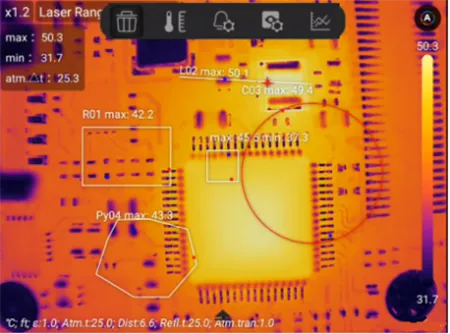
Handheld thermal cameras that only measure the temperature at a central point are relatively cheap. In contrast, if they have the functions of moving points, moving areas, high-temperature capture, and high-temperature alarms, the price will be higher. Typically, well-known brands that offer high-quality construction will include these advanced features.
5. Brand
The competition in the thermal imaging camera market is very intense, and every brand faces a certain level of pressure. Generally, thermal cameras from well-known brands tend to be more expensive; at the same time, the quality is reliable and trustworthy, and any issues can be addressed with the seller’s help. The after-sales service is also excellent, and when problems arise, contacting customer support can save a significant amount of money. Typically, products from major brands come with high-quality after-sales service.
Conclusion
The relatively high cost of thermal imagers can be attributed to a variety of factors, mainly the lenses, detectors, algorithms, and circuits. The scarcity of manufacturing materials, the large investment in research and development, the multiple functions of the thermal imager, and the temperature measurement range and method all affect the cost of thermal imagers.
Although the price of thermal imagers may seem high at first, considering the wide applications and long-term benefits provided by its advanced technology, it is definitely a high return on investment product.