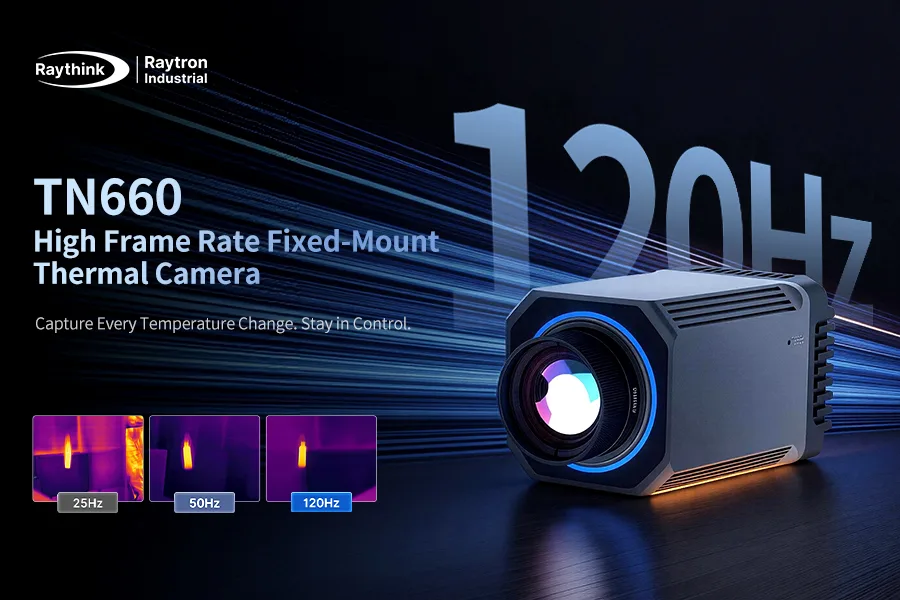
When targets move quickly, or temperatures change over a short period, the timing of thermal measurements matters. Engineers need to understand where a temperature change occurs and how it develops. Raytron Industrial has introduced the TN660 High Frame Rate Fixed-Mount Thermal Camera to support these tasks. It delivers full-frame 640 × 512 thermal imaging at 120 Hz, together with synchronized temperature data and software for analysis and review.

Designed for research and testing, industrial automation, rail transportation and road traffic applications, the TN660 combines an uncooled detector, industrial connectivity and external triggering in a compact camera. Its higher frame rate supports applications involving moving components, transient heating and cooling, and short-duration thermal events.

1. Full-Resolution Thermal Imaging at 120 Hz
Built around a 12 μm uncooled VOx detector, the TN660 delivers full-frame 640 × 512 thermal imaging at 120 Hz. It achieves this high frame rate without compromising resolution.
At 120 Hz, successive frames are approximately 8.33 ms apart, providing about 12 frames over a 100 ms event. This closely spaced sequence helps engineers examine rapid heating and cooling trends, while full-frame acquisition preserves the complete image area for observing moving targets and surrounding regions.
Raythink’s proprietary image processing algorithms help retain image detail in dynamic scenes, while a NETD of ≤40 mK (at 25°C, F/1.0 and 120 Hz) supports the detection of subtle temperature differences.

2. From Synchronized Data Acquisition to Analysis
The TN660 offers two temperature measurement ranges, −20°C to 150°C and 100°C to 650°C, with an accuracy of ±2°C or ±2% of the reading, whichever is greater. It can stream thermal images and temperature data separately or together in sync. Synchronized output pairs temperature readings with the corresponding imagery, helping engineers examine where thermal changes occur and how they develop during a test or production process.
To analyse these images and temperature data, users can work with Raythink’s TI Studio temperature analysis software. It provides tools for live monitoring, recording, alarms and offline review, with simultaneous preview and analysis of up to four cameras. Users can configure measurement rules, set temperature and temperature-rise alarms, and review and export historical temperature curves. Real-time displays of acquisition and processing frame rates help users check data handling during operation.
Recorded thermal data can be revisited for further analysis and report generation, helping engineering teams investigate temperature anomalies and document their findings.

3. Flexible Integration into Test and Automation Systems
Hardware and software triggering allow image acquisition to be coordinated with external equipment signals. Through its I/O (input/output) interface, the TN660 can use an external electrical signal to initiate image capture or recording at a selected stage in a test or production cycle. For example, a signal marking the start of a heat-press cycle can initiate recording of the associated thermal process.
By focusing recording on relevant events, users can reduce unnecessary stored data and the time spent searching through long recordings. This is particularly useful for repetitive cycles and short-duration tests, where thermal changes need to be associated with a specific equipment action.
The camera provides RJ45 Gigabit Ethernet, USB 3.0 UVC and RS485 connectivity, with support for Modbus TCP/RTU, MQTT and ONVIF. These options allow system integrators to incorporate thermal imaging and temperature data into different test and monitoring architectures. Temperature alarms, thermal image capture and configurable alarm outputs support event documentation and communication with external systems.

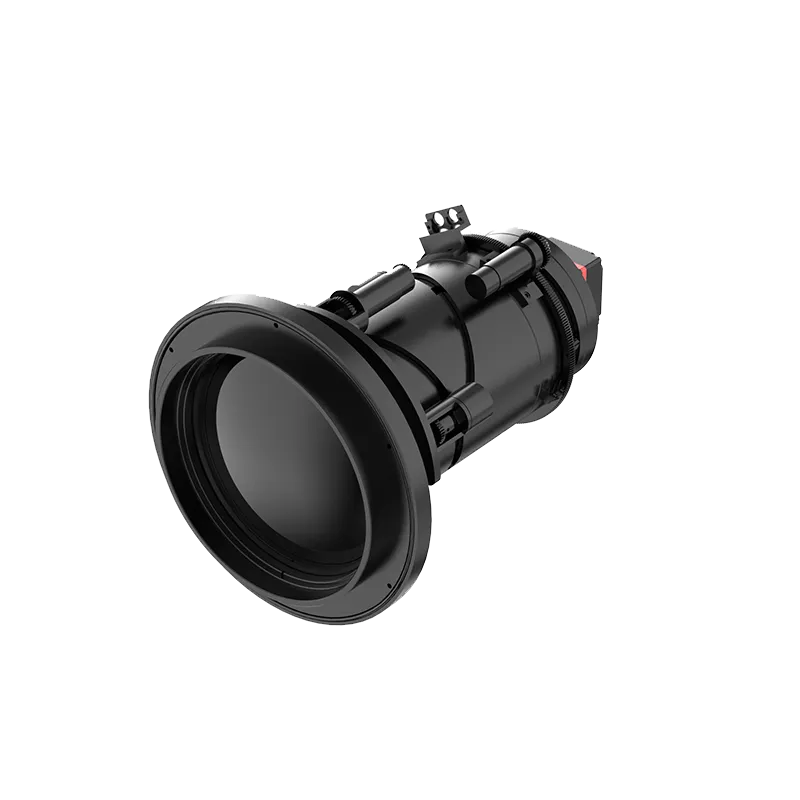
Installation flexibility extends to the camera’s optics and housing. A choice of 9.1 mm and 25 mm lenses accommodates different target sizes, working distances and coverage requirements. Weighing approximately 290 g and measuring approximately 92 × 49 × 49 mm, the TN660 fits into machinery and test setups where space is limited. It supports 9–36 V DC or Power over Ethernet, with typical power consumption below 4.5 W.