Selecting the appropriate gas leak detection method is critical in industrial safety and environmental management. Different gas types and risk levels dictate detection strategies, ranging from chemical reagents and bubble methods to PID and infrared gas imaging. Each method has distinct applications and limitations. This article systematically introduces mainstream gas leak detection methods and their characteristics, providing you with a clear reference while demonstrating the advantages of Raythink’s OGI solutions in practical applications.
1. Industrial Gas Classification and Corresponding Detection Strategies
Before selecting gas leak detection methods, the primary question is clarifying “what to detect” and “why detect it.” Rather than relying solely on chemical properties, gas classification based on application objectives and risk dimensions offers greater practical guidance and helps match appropriate detection methods.
- Combustible Gases (Safety Risk-Focused)
The primary risk from these gases is that leaks may trigger combustion or explosions, making them a focus of industrial safety management. Typical examples include methane (CH4) and ethylene (C2H4).
Detection Priority: Rapid response—warnings must be issued before gas accumulation occurs.
- Toxic or Irritant Gases (Personnel Health-Focused)
Even at trace concentrations, these gases pose serious health threats to personnel. Common examples include ammonia (NH3), hydrogen sulfide (H2S), and sulfur- or nitrogen-containing industrial gases.
Detection Priority: Early detection and personnel safety assurance.
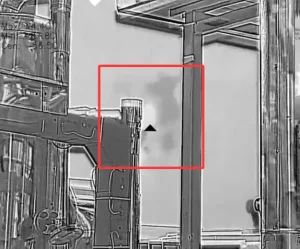
- Greenhouse Gases and Specialty Industrial Gases (Environmental Compliance-Focused)
These gases are critical for environmental impact and regulatory compliance, including carbon dioxide (CO2), sulfur hexafluoride (SF6), and methane (CH4). Methane, as a greenhouse gas, is incorporated into carbon emission management, illustrating the multi-faceted nature of gases.
Detection Priority: Environmental monitoring, compliance management, and long-term emission control.
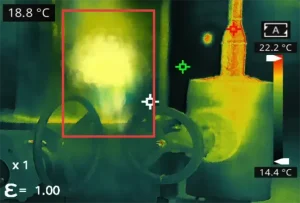
2. Redefining “Conventional” and “Advanced” Gas Leak Detection Methods
When selecting detection methods, beyond clarifying “what” and “why,” it’s essential to understand the characteristics and applicable scenarios of different approaches. Gas leak detection methods are not simply categorized by historical timeline as “conventional” versus “advanced,” but rather by detection methodology, coverage capability, efficiency, and level of response to leak incidents.
- Conventional methods typically rely on contact or point-based detection, heavily dependent on manual operation—suitable for localized verification or small-scale inspection in controlled environments or low-risk scenarios.
- Advanced methods predominantly employ non-contact, long-range, or visualization technologies, enabling rapid localization of unknown leak sources and achieving area coverage and systematic management—better suited to modern industrial facilities’ high demands for efficiency and safety.
3. Conventional Gas Leak Detection Methods
1) Chemical Reagent Method
The chemical reagent method detects leaks through color changes when gas reacts with specific reagents, or uses permeable dyes that penetrate small crevices to assist in determining whether leaks exist. This method relies on manually applying or spraying reagents, with detection completion through visual observation of reaction results. It is low-cost and sensitive to minute leaks, making it suitable for laboratory or small equipment maintenance.
However, reaction times are lengthy, detection efficiency is low, and results highly depend on operator experience—unsuitable for complex industrial scenarios or large-scale inspections.
2) Bubble Leak Testing
The bubble test applies a bubble solution to pipes or connection points, causing escaping gas to form visible bubbles at the leak point, thus assisting in leak location determination. The principle is intuitive and operation is simple. Its advantage lies in low cost and no requirement for complex equipment, suitable for low-pressure systems or localized maintenance.
However, detection efficiency is low, relying solely on visual observation, making it prone to missing minute leaks or leaks in complex environments—unsuitable for continuously operating industrial facilities.
3) Photoionization Detector (PID)
PID (Photoionization Detector) uses ultraviolet light to ionize gas molecules and measures gas concentration by detecting ion current. It is primarily used for low-concentration detection of VOCs and certain inorganic gases, typically deployed as lightweight handheld devices. PID offers high sensitivity and rapid response, suitable for field inspection and personal protection.
However, it provides only point-based detection without imaging or leak source localization capabilities—more often used for safety monitoring or auxiliary determination rather than comprehensive leak detection solutions.
4) Flame Ionization Detection Method (FID)
FID (Flame Ionization Detector) uses hydrogen flame as the ionization source, causing organic matter to combust and produce ion current. It has extremely high sensitivity to hydrocarbon gases, with response levels positively correlated to carbon atom count.
While offering high detection accuracy, the method is limited in field inspections and routine leak detection due to its bulky equipment, hydrogen cylinder requirements, complex operation with safety risks, and the destructive nature of detection processes.
5) Electrochemical Gas Sensor
Electrochemical detection enables continuous monitoring of specific gas concentrations through chemical reactions between gases and sensor’s internal electrodes, which produce electrical signals. It is widely applied in fixed or portable safety monitoring systems. It offers controllable cost and favorable selectivity, making it suitable for long-term monitoring.
However, this method is fundamentally a point-based concentration detection that cannot visualize or accurately locate leaks, prone to false positives or missed detections in outdoor environments or areas with complex airflow patterns.
4. Advanced Gas Leak Detection Methods
1) Fourier Transform Infrared (FTIR)
FTIR gas telemeter obtains gas absorption characteristics through interference modulation and spectral analysis, enabling simultaneous detection of multiple gas components with high resolution and sensitivity. Typically deployed as gimbal or portable systems, FTIR suits industrial scenarios with mixed gases or obvious component analysis requirements.
However, its high system cost and data processing delays make it unsuitable for immediate response to rapid leak events.
2) Tunable Diode Laser Absorption Spectroscopy (TDLAS)
TDLAS technology detects gases based on their absorption characteristics at specific laser wavelengths, offering exceptional sensitivity and selectivity. It is commonly used for long-range measurement of single target gases, providing high detection accuracy and rapid response.
This method cannot image—detection results are presented numerically and easily susceptible to environmental interference, making it more suitable as a quantitative monitoring tool rather than a leak visualization device.
3) Acoustic Detection Technology
Acoustic detection captures anomalous sound wave signals produced as gas escapes from leak points. It infers leak locations by analyzing frequency or intensity changes, commonly used for pipeline system monitoring. Its equipment is relatively low-cost, making it suitable for long-distance pipelines.
However, it is easily disturbed in industrial environments with high noise levels, carries high false alarm risk, and has limited adaptability to complex conditions.
4) Infrared Gas Detection (Optical Gas Imaging, OGI)
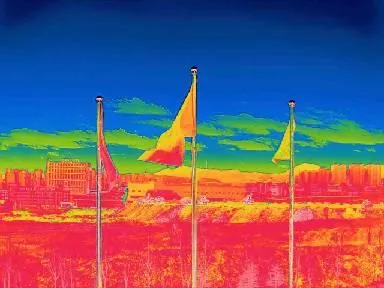
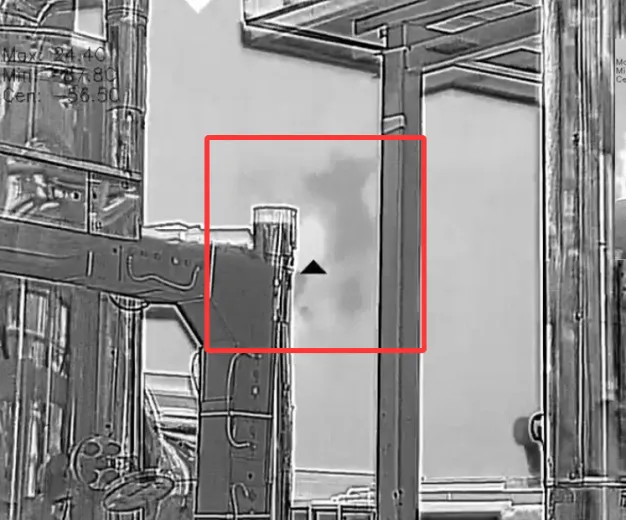
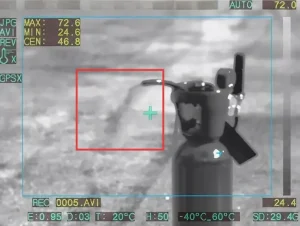
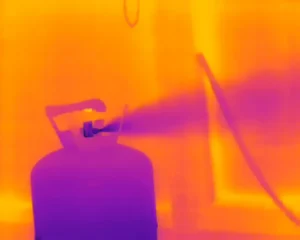
Infrared gas detection is based on differences in infrared radiation absorption characteristics among different gases. Through infrared detectors, it converts invisible gas leaks into intuitive visual gas cloud images. Gases form a distinct contrast in background infrared radiation, enabling rapid identification of leak location, dispersion direction, and relative scale.
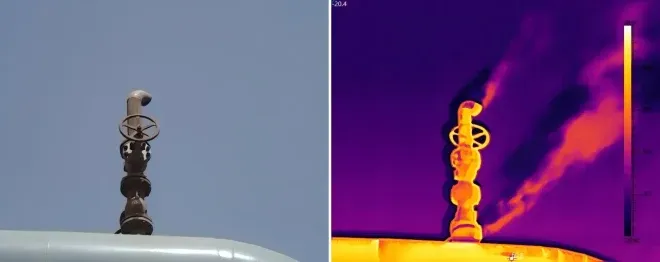
This method enables long-range, large-area inspections without production shutdown, suitable for complex industrial facilities and continuous operation scenarios. For gases with infrared absorption characteristics, such as carbon dioxide, methane, and sulfur hexafluoride, infrared gas imaging demonstrates significant advantages in efficiency, visualization, and response speed, making it a core technology in modern industrial gas leak detection systems.
5. Gas Leak Detection Methods Comparison Overview
| Detection Method | Advantages | Disadvantages |
| Chemical Reagent | Low cost, high sensitivity | Long reaction time, low detection efficiency |
| Bubble Test | Low cost | Reliant on visual observation, low detection efficiency |
| Electrochemical Sensor | Low cost, high sensitivity | No imaging capability, prone to false negatives/positives in outdoor scenarios, frequent sensor replacement needed |
| FTIR | High detection speed, capable of identifying gas components | High cost, time-delayed |
| TDLAS | Lower cost than infrared methods, high detection sensitivity | No imaging capability, prone to false alarms |
| PID | High reliability, long service life, high sensitivity | No imaging capability |
| FID | High sensitivity | hydrogen cylinder replacement needed, certain hazards, unable to image |
| Acoustic | High sensitivity | Prone to noise interference, high false alarm rate, suitable only for low-noise pipeline scenarios |
| OGI | Real-time imaging, applicable for security monitoring, high sensitivity, long service life | Unable to detect gas components, certain background temperature differential needed |
6. Raythink: Leading Infrared Gas Detection Solutions
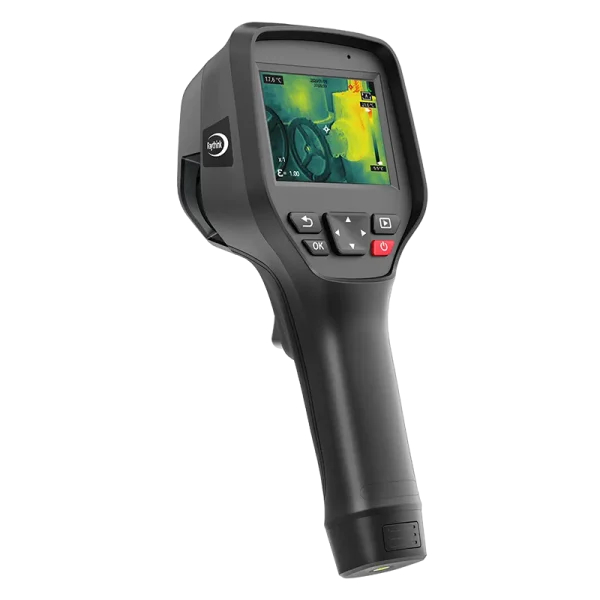
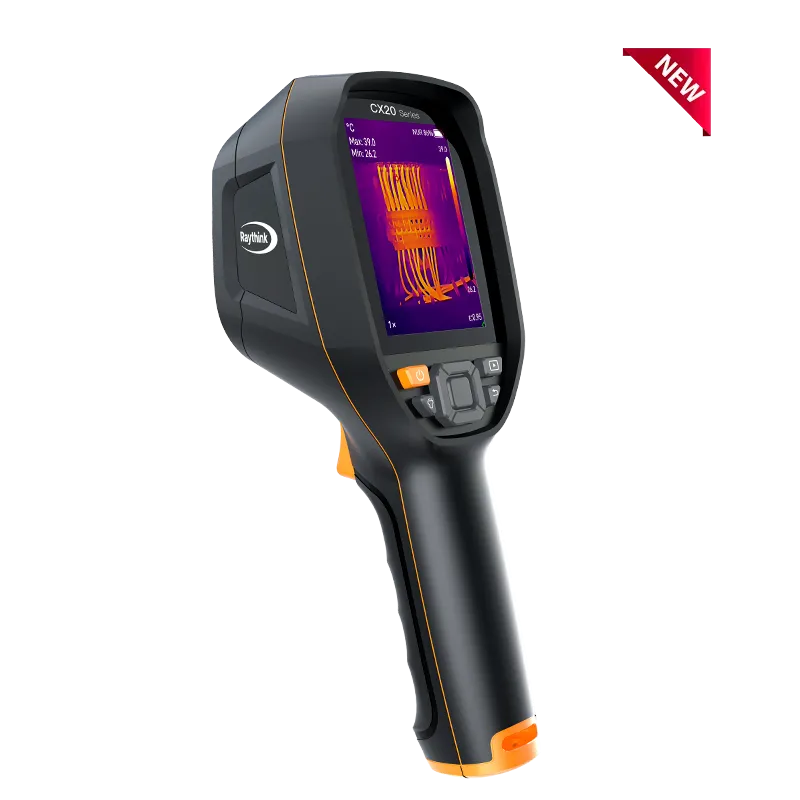
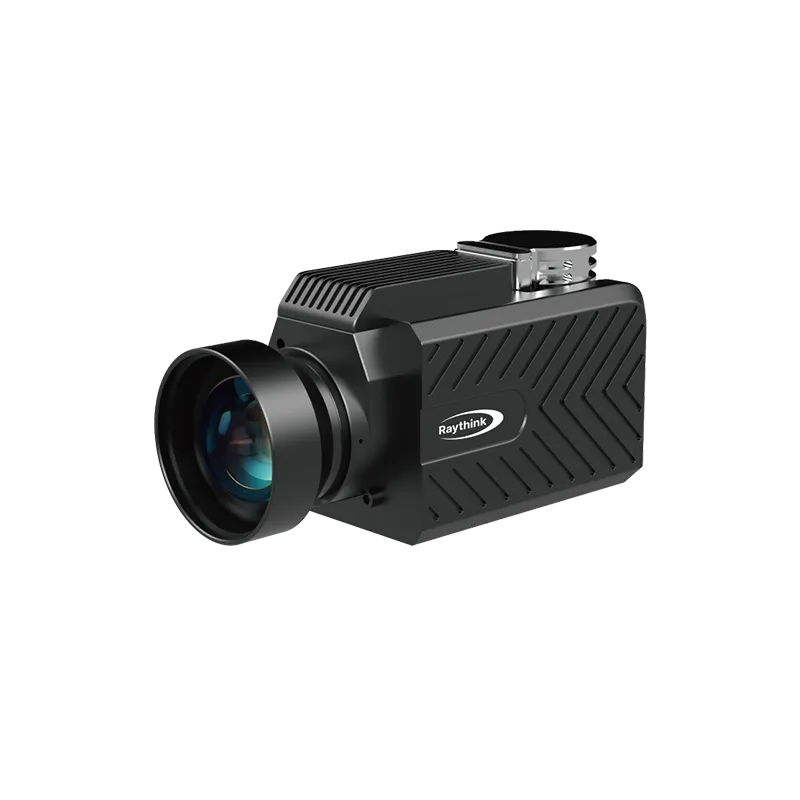
In the advanced gas detection field, Raythink specializes in the deep application of infrared gas imaging technology, emphasizing OGI camera spectral customization and scenario adaptation. We provide integrated system solutions combining handheld inspection, online monitoring, and data platform management, meeting diverse industry requirements for comprehensive gas leak detection across all scenarios.
1) OGI Camera Lineup
2) Systematic Solution Architecture
① Routine Handheld Inspections: Professionals conduct periodic scans using OGI handheld cameras, achieving comprehensive coverage and detailed identification. OGI’s visualization capability enables a single operator to cover hundreds of components in one day, rapidly identifying potential leaks.
② Online Monitoring in Critical Areas: Deploy dual-spectrum gas imaging PTZ cameras in high-risk areas to perform 24/7 automatic scanning with preset patrol routes. This fills temporal gaps in manual inspections, achieving continuous monitoring.
③ Unified Data Platform Management: Data from all handheld and online OGI cameras converge to a unified platform for visual analysis, trend monitoring, and alarm linkage, supporting enterprise asset management and informed decision-making.
3) Typical Industry Application Scenarios
① Petrochemical Industry: At critical parts like storage tank areas, unloading interfaces, pipes, and valves, Raythink solutions combine handheld inspections with online monitoring to achieve comprehensive gas leak detection. The system can integrate gas and temperature & humidity sensors through IoT gateways, providing real-time data supporting refined risk management.
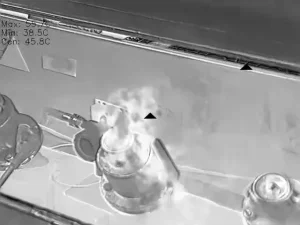
② Power Industry: For high-voltage electrical equipment, boilers, ammonia production facilities and gas-fired power plants, Raythink solutions provide real-time monitoring of SF6, ammonia, sulfur dioxide, nitrogen oxide, and other gas leaks. High-resolution uncooled VOX detectors enable remote, non-disruptive visual monitoring, rapidly locating gas leak points and quantifying leak severity.
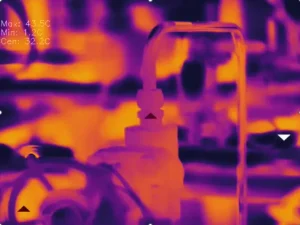
③ Environmental Monitoring: For air pollution and enterprise emission control, Raythink solutions cover pollutants including VOCs, CO2, and toxic gases. Optical gas imaging cameras provide intuitive visual data, helping regulatory agencies assess emission compliance and implement mitigation measures.
7. Conclusion
Mastering various gas leak detection methods helps enterprises scientifically select technical solutions, enhancing safety and efficiency. Raythink’s OGI system achieves comprehensive leak visualization and risk control through high-sensitivity infrared gas imaging, handheld and online monitoring, and intelligent data management. For customized solutions, contact Raythink for professional consultation and technical support.